
PCB Testing and Inspection
Test is not a sample taken at the end. It is the condition a panel has to satisfy before it moves to the next stage — and the reason a certificate can travel with the shipment.
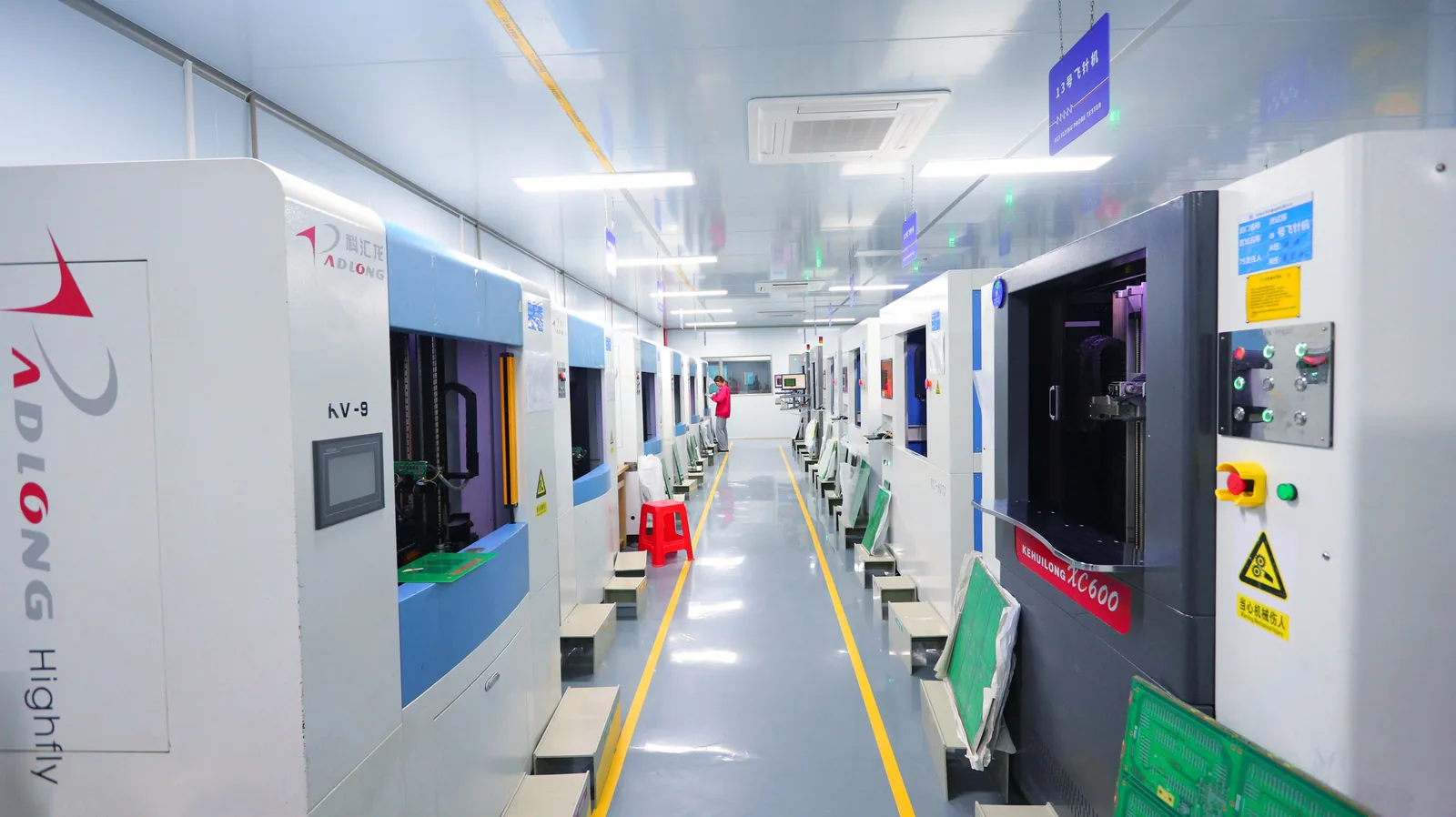
Quality is a gate, not a report written afterwards.
A panel moves forward only when the previous stage has passed. That single rule removes most of the ways a defect survives to shipment: an inner-layer open cannot be covered by a later AOI pass if the panel never reaches lamination, and a plated barrel cannot be argued about two weeks later if the thickness was measured at plating.
What leaves the plant is therefore documented rather than asserted. Every shipment carries a Certificate of Conformance stating the IPC class, the surface finish and the copper weights built, and impedance-controlled orders get their TDR results appended to it. Where a figure is not on the paper, it was not measured — and we would rather say that than fill in a default.
Four stages, each one a gate.
Material verification
Tg, copper peel strength, dimensional flatness and supplier certification checked before anything reaches imaging.
In-process gates
AOI after inner-layer etch, diameter and registration after drilling, copper thickness after plating, AOI again after outer-layer etch.
Finished board test
100% electrical test on every panel, then dimensional and visual inspection to IPC-A-600 before packing.
Reliability sampling
Thermal cycling coupons, ionic contamination and solderability monitored on a schedule, traceable to the lot.
Six methods, and what each one actually catches.
Optical and electrical
| Method | What it catches | Where it runs | Coverage |
|---|---|---|---|
| AOI | Opens, shorts, missing copper, line-width drift, mask registration | After inner-layer etch and again after outer-layer etch | 100% of panels |
| Flying probe | Continuity and isolation on every net, no fixture required | Prototypes, NPI and low volume | 100% of nets |
| Fixture test | The same electrical coverage at volume speed | Repeat production runs, fixture stored and reused | 100% of nets |
| TDR | Characteristic impedance on coupons built into the panel | Controlled-impedance orders | Coupon per panel |
Physical and subsurface
| Method | What it catches | Where it runs | Coverage |
|---|---|---|---|
| Cross-section | Plated copper thickness, drill quality, voids, lamination integrity | Sampling to IPC-A-600, plus failure analysis on demand | Destructive sample |
| X-ray | Buried via fill quality, interconnection defects, drill-to-pad registration | HDI via-in-pad and fine-pitch via structures | Sampled, or on request |
Impedance is held to ±5% as standard, ±3% on request, with TDR measured on a coupon per panel and the results attached to the CoC. Every build runs to IPC Class 2 standard, Class 3 on request.
Three things the paperwork has to answer.
The IPC class, stated
Class 3 tightens copper plating thickness, annular ring and sampling rather than adding a new test. It is quoted on request and recorded on the certificate, so the class on the drawing and the class on the paper are the same one.
Traceable to the laminate lot
Every order keeps a thread from laminate batch number to finished board. Supplier batch certificates are retained and released on request, which is what a customer qualification audit usually asks for first.
A CoC with every shipment
The certificate names the IPC class, the surface finish and any controlled-impedance requirement. For impedance orders the TDR results are appended rather than summarised.
Need a specific test written into the order?
Name the method and the acceptance criterion. It goes on the drawing and the certificate, not into a side conversation.
Questions about what is actually measured.
Is the electrical test really 100%?
On every panel, before routing. Flying probe covers all nets on prototypes and NPI where no fixture exists; volume runs use a bed-of-nails fixture at the same coverage and a fraction of the cycle time. Neither is a sample.
What actually changes when I specify Class 3?
Copper plating thickness, annular ring minimums and sampling frequency all tighten, and the inspection standard moves from Class 2 acceptance to Class 3. It is not an extra test bolted on at the end — it changes what the earlier stages are allowed to pass.
Do I receive the TDR data?
Yes, for controlled-impedance orders. The coupon results are appended to the Certificate of Conformance rather than condensed into a pass mark, so the measured values against your target are visible.
Can you run thermal shock or IST for a qualification?
Both are available as add-on services, alongside humidity resistance testing, with results traceable to the production lot. They are quoted per project because the profiles differ between customers.
What happens when a panel fails?
It leaves the flow at that gate. Depending on the defect it is reworked under a documented procedure and re-tested, or scrapped and replaced from the same lot — never advanced with a note. The disposition is recorded against the order.
Want the acceptance criteria fixed before the order?
Send the drawing with the test requirements on it. Quote in 24 hours, certificate to match.