
Through-Hole Assembly
Through-hole parts carry the current and take the mechanical load. Which of the three soldering methods gets used is decided by what is already sitting on the bottom side.
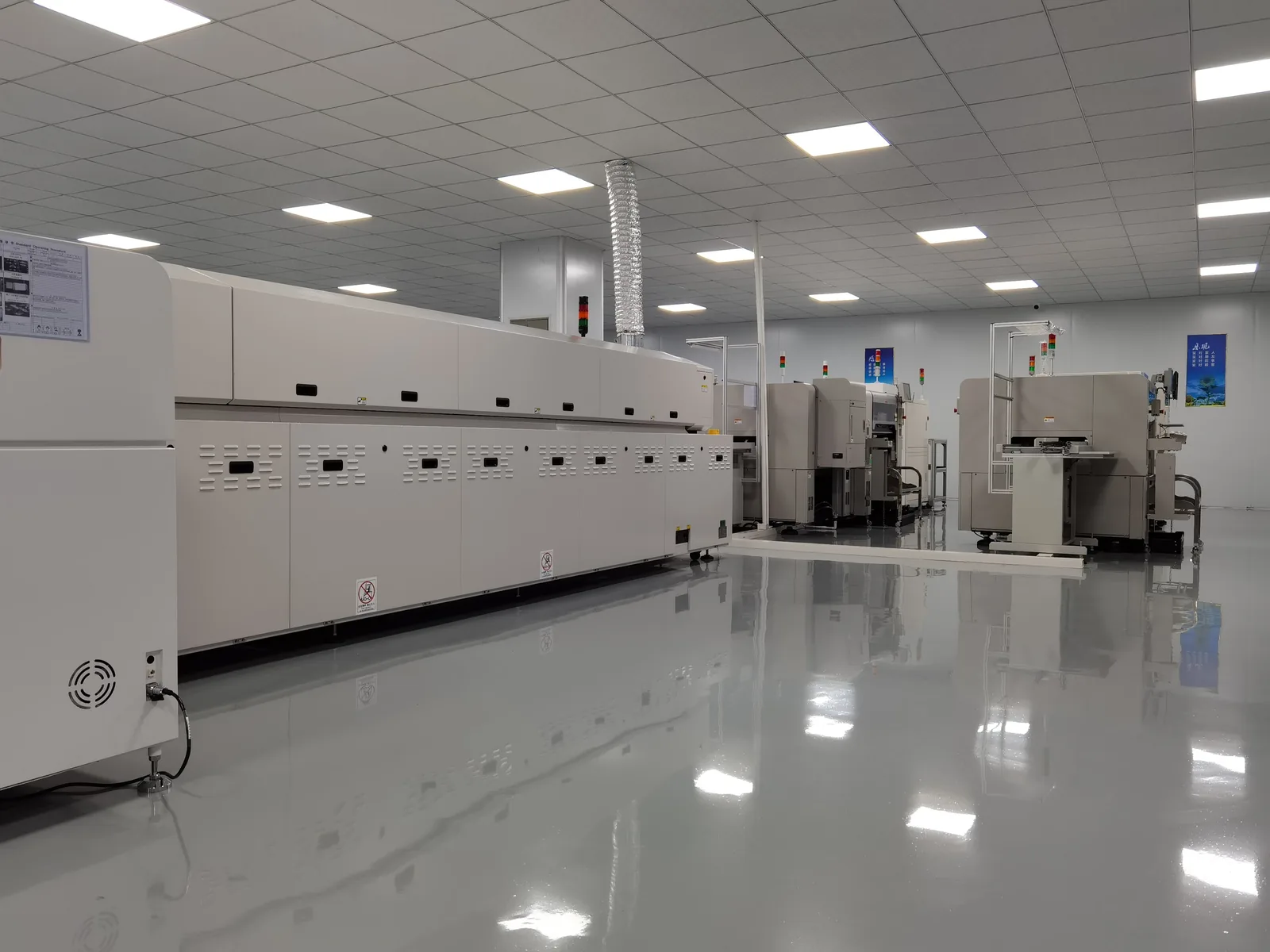
Three ways to solder a pin, and a reason for each.
A through-hole joint is judged on two things the surface-mount joint is not: how much current it can carry, and how well it survives being pushed, pulled and vibrated. That is why connectors, transformers, cased capacitors and power devices stay through-hole long after everything else has moved to surface-mount.
Wave soldering is the fast answer when the whole bottom side can take it. Selective soldering exists for the opposite case: bottom-side surface-mount parts that would be destroyed by a full wave. A robotic iron covers the joints neither can reach — a single tall connector, a pin next to a heat-sensitive part.
What the line holds, and what has to be agreed first.
Insertion and soldering
| Parameter | Capability |
|---|---|
| Insertion | Hand insertion standard; auto-insertion for repetitive high-volume parts |
| Soldering methods | Full wave, selective wave, robotic soldering iron |
| Maximum board | 560 × 480 mm |
| Press-fit connectors | Inserted without soldering; hole tolerance agreed at DFM |
| Cleaning | Aqueous inline with DI rinse where low ionic contamination is specified |
Verification
| Parameter | Capability |
|---|---|
| Joint inspection | AOI plus visual inspection to IPC-A-610 |
| Hi-pot | Available to customer-specified voltage |
| Electrical test | Flying probe, fixture or functional test as ordered |
| Standards | IPC-A-610 Class 2 standard, Class 3 on request; J-STD-001 |
| Handling | Class 0 / 1 / 2 ESD-protected lines |
A through-hole-only board skips the surface-mount stage entirely. Where the board also carries surface-mount parts, the sequence becomes two passes and is quoted as a mixed-technology order — the two are priced differently because the second pass has to protect the first. Every build runs to IPC Class 2 standard, Class 3 on request.
Where through-hole work goes wrong.
Selective soldering protects what is already there
A full wave would drag solder across bottom-side surface-mount parts and reflow them on the way past. Selective soldering brings a mini-pot nozzle to each through-hole joint instead, so the neighbouring surface-mount work never sees the wave. It is slower per joint and it is the reason mixed boards are buildable at all.
A wave is a panel decision
Solder shadowing behind tall parts, thermal mass in a thick ground plane, and solder mask dams between fine pads all decide whether a full wave can be used. These are checked at DFM review, because fixing them afterwards means a pallet, a rework loop, or both.
Hand insertion is fixtured, not improvised
Connectors and transformers are heavy, polarised and often the part that defines the mechanical envelope. Insertion is done against the assembly drawing with the part supported and the leads clinched before soldering, so the joint is not also holding the weight.
Hi-pot where the board carries mains
Power and energy boards are voltage-withstand tested to the figure the customer specifies, with the test points and the pass criterion agreed before the order. It is a safety check on the assembly, not a functional test, and the two are reported separately.
Mixed board with bottom-side surface-mount?
Send the assembly drawing with the sides marked. The soldering method is chosen at DFM review and named in the quote.
What comes up on through-hole orders.
How do you decide between wave and selective soldering?
By what else is on the bottom side. If it is clear of surface-mount parts, a full wave solders every joint in one pass and is the cheaper route. If there are bottom-side surface-mount parts near the through-hole pins, selective soldering protects them. On many boards both are used, on different areas of the same panel.
Can you assemble a through-hole-only board?
Yes. A board with no surface-mount parts goes straight from insertion to wave soldering, with no reflow stage at all. It is the simplest path through the building, and it is also the one where hand insertion quality decides the result.
Do large parts like transformers have to be customer-supplied?
Often they are, because the mechanical fit and the winding specification are design-specific. We will source them on a turnkey order if they are available through an authorised distributor, but the lead time on a custom transformer is usually the longest single item in the build, so it is worth flagging early.
Is hi-pot testing included as standard?
It is available, not automatic. The voltage, the duration, the test points and the leakage limit all have to be specified, and they belong in the order rather than being guessed at the end of the line. Boards that do not carry mains rarely need it.
What about press-fit connectors?
Press-fit parts are inserted without solder, so the joint relies on the hole diameter and the plating rather than on a fillet. That makes hole tolerance a fabrication requirement, checked at DFM review against the connector datasheet — by the time the board is at assembly, the hole is already drilled.
Through-hole work with the method still open?
Send the assembly drawing. Quote in 24 hours, with the soldering method and any hi-pot requirement written into it.