
PCB Materials
The laminate decides impedance, loss, thermal margin and flex life before a single trace is routed. Here is what we hold, what we order against demand, and the numbers we quote against.
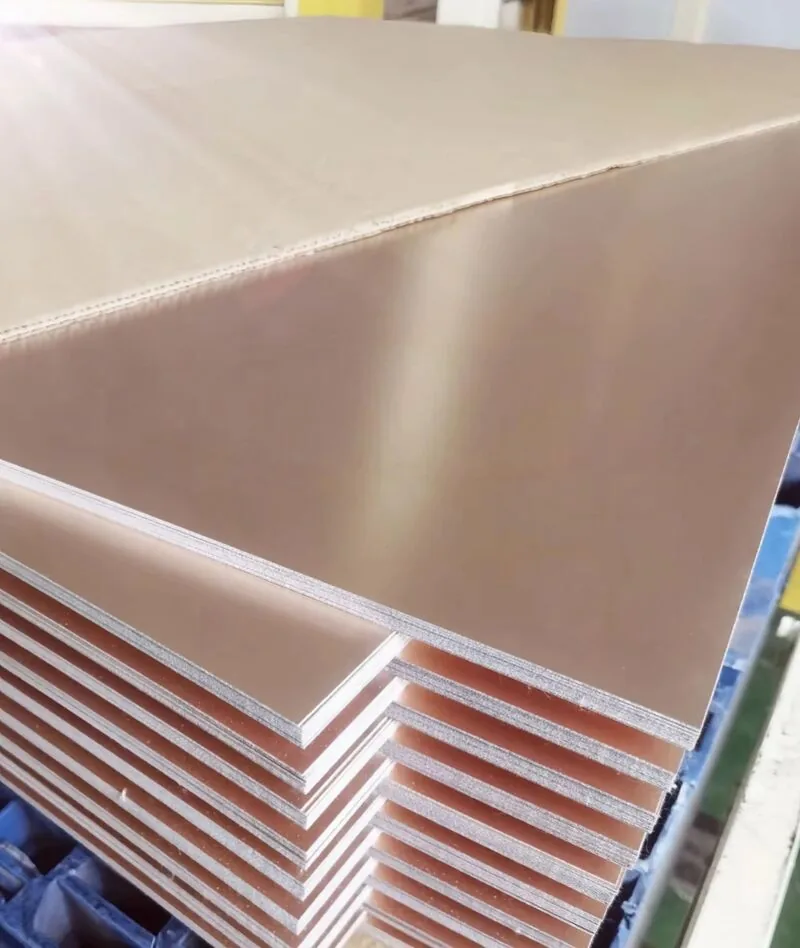
Five properties decide the choice, and they pull against each other.
Dielectric constant sets the trace width that lands on your target impedance. Loss tangent sets how much of the signal survives the run. Glass transition temperature sets the ceiling for assembly and operating heat. Thermal conductivity decides where the heat goes. Coefficient of thermal expansion decides whether the vias still connect after a thousand cycles. Change the laminate to fix one of those and the other four move.
So we do not quote from a catalogue page. We read the stack-up against the frequency, the ambient temperature and the watts you need to move, then name the family that survives all three. Where the specified laminate and the design disagree — standard FR-4 under a 10 GHz line, for instance — the note comes back at DFM, before tooling rather than after.
Five families, and what each one is actually for.
A · FR-4 family
| Family | Tg / thermal | Dk / Df | Where it earns its cost |
|---|---|---|---|
| Standard FR-4 | Tg 130–150°C | Dk 4.2–4.6 / Df 0.015–0.020 @ 1 GHz | Digital and industrial boards below 3 GHz |
| Heavy-copper FR-4 | Tg 150–170°C | Same dielectric family | 4–6 oz copper, where heat leaves through the trace |
| High-Tg FR-4 | Tg 170–180°C | Same dielectric family | Repeated lead-free reflow, automotive, elevated ambient |
| Low-loss FR-4 | — | Dk 3.4–4.0 / Df 0.002–0.005 @ 1 GHz | 10–25 Gbps channels on an FR-4 budget |
B · Rogers and PTFE
| Family | Tg / thermal | Dk / Df | Where it earns its cost |
|---|---|---|---|
| Rogers RO4003C | — | Dk 3.55 / Df 0.0027 @ 10 GHz | Impedance-sensitive RF, processed on FR-4 lines |
| Rogers RO4350B | — | Dk 3.66 / Df 0.0037 @ 10 GHz | 5G sub-6, antennas, volume RF work |
| RT/duroid 5880 | — | Dk 2.20 / Df 0.0009 @ 10 GHz | Millimetre-wave, lowest loss available |
C · Ceramic
| Family | Tg / thermal | Dk / Df | Where it earns its cost |
|---|---|---|---|
| Al₂O₃ ceramic | ~ 24 W/m·K, CTE 3–6 ppm/°C | — | Power modules and LED substrates |
| AlN ceramic | ~ 170 W/m·K, CTE 3–6 ppm/°C | — | High power density, RF, CTE matching to GaN |
D · Metal core
| Family | Tg / thermal | Dk / Df | Where it earns its cost |
|---|---|---|---|
| Metal core (MCPCB) | 1–3 W/m·K; ceramic-filled 8–12 W/m·K | — | LED arrays and power supplies, single or double layer |
E · Polyimide flex
| Family | Tg / thermal | Dk / Df | Where it earns its cost |
|---|---|---|---|
| Polyimide flex | −200 to +400°C service | — | Dynamic flex and rigid-flex; 0.2 mm flex section on inquiry |
Metal-core dielectric runs 75–150 µm and the base is 0.8–2.0 mm, giving a finished board of 0.8–3.2 mm. Ceramic substrates cannot take HASL-LF or OSP — the finish list narrows to ENIG, immersion silver, immersion tin or hard gold. Every build runs to IPC Class 2 standard, Class 3 on request, whichever laminate is specified.
The same numbers, with the frequency they were measured at.
Values we quote against
| Material | Dk | Df | Measured at |
|---|---|---|---|
| Standard FR-4 | 4.2–4.6 | 0.015–0.020 | 1 GHz |
| Low-loss FR-4 | 3.4–4.0 | 0.002–0.005 | 1 GHz |
| Rogers RO4003C | 3.55 | 0.0027 | 10 GHz |
| Rogers RO4350B | 3.66 | 0.0037 | 10 GHz |
| RT/duroid 5880 | 2.20 | 0.0009 | 10 GHz |
A Dk figure without its test frequency is not a specification. FR-4 Dk drifts across the 1–10 GHz span, which is why the two families above are not quoted on the same basis. Laminate certificates carry the lot values; the table is the design basis.
Three things that happen before the first panel.
Material review sits inside DFM
The stack-up is read against the frequency, the ambient and the watts. A mismatch is raised as a DFM note with the alternative named — not discovered at first article.
Grades held for quick-turn
Standard FR-4, High-Tg FR-4, RO4003C, RO4350B and aluminium core stock are held for prototype and quick-turn work. PTFE composites, AlN and polyimide are ordered against confirmed demand.
Certificates travel with the order
Laminate Certificates of Conformance state grade, Tg, flammability class and lot number. Aerospace and medical supply chains usually need them filed against the build record.
Laminate undecided, and layout waiting on it?
Send the frequency range, the ambient temperature and the watts. The answer comes back with a family and a reason.
Material questions that come up before layout.
When does standard FR-4 stop being the right answer?
Above roughly 3 GHz the Dk tolerance starts moving impedance more than your trace width can absorb, and loss becomes the dominant term. Below that, standard FR-4 is well characterised and the cheapest correct choice. Digital designs with 10 Gbps or faster edges usually want the low-loss grades even when the clock looks comfortable.
What actually separates RO4003C from RO4350B?
Dk 3.55 against 3.66, with comparable loss. 4003C is the tighter choice when impedance has to hold across a batch; 4350B is more widely stocked and usually cheaper at volume, which is why most sub-6 GHz antenna work lands there.
Can Rogers and FR-4 share one stack-up?
Yes, and it is the usual way to keep an RF board affordable — Rogers on the signal layers that carry the microwave, FR-4 on the rest. The two expand at different rates, so the lamination cycle is built around that difference rather than assuming it away.
Do you supply halogen-free laminates?
In standard FR-4, High-Tg FR-4 and several specialty grades, to IEC 61249-2-21. Say so on the order — availability is confirmed at quotation, because not every grade is held in the halogen-free variant.
Which laminate suits a high-power LED driver?
Aluminium metal core once a single emitter passes about 1 W, because the base spreads heat in a way copper pours cannot. Ceramic-filled dielectric at 8–12 W/m·K covers denser arrays; AlN takes over where the watt density outruns metal core entirely.
Want the laminate checked against your stack-up?
Send the design and the operating conditions. Quote in 24 hours, with the material question answered in writing.