
High-TG FR4 PCB
Tg is the temperature where the resin stops behaving like a solid. Everything above it — reflow passes, operating ambient, thermal cycling — is where a standard laminate starts to cost you yield.
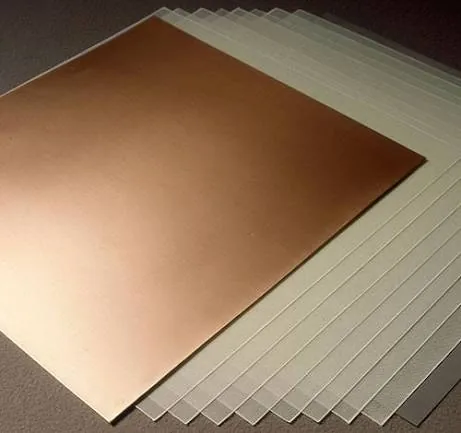
It is not a better FR-4. It is the same FR-4 with a higher ceiling.
A High-TG laminate keeps the electrical behaviour of FR-4 — same Dk family, same process, same etching and lamination lines — and raises the glass transition temperature from the 130–150°C band to 170–180°C. Below its Tg the board expands predictably. Above it the resin softens, expansion runs away, and the plated barrel through a via starts carrying the difference.
That is why the upgrade is decided by the assembly and the environment rather than by the signal. A board that sees four lead-free reflow passes, or sits at 105°C for years, is asking the laminate to hold dimensions above the point where standard FR-4 stops holding them. Where it stays cool and sees one or two passes, the standard grade is the correct and cheaper choice.
Where each Tg band belongs.
Bands we quote from
| Grade | Tg | Chosen when | What it does not solve |
|---|---|---|---|
| Standard FR-4 | 130–150°C | One or two lead-free reflow passes, ambient below 100°C | Multiple passes or continuous heat above Tg |
| Heavy-copper FR-4 | 150–170°C | 4–6 oz copper, where the copper weight itself drives the grade | Fine-pitch multilayer — it is a copper solution, not a thermal one |
| High-TG FR-4 | 170–180°C | Repeated lead-free reflow, automotive, elevated ambient | Loss at 10 GHz — Tg does not lower Df |
These are the only three bands we quote. A supplier naming a fourth Tg window is usually quoting a different laminate family under the same label. Dk stays in the 4.2–4.6 range at 1 GHz across all three, so a Tg upgrade does not change your impedance stack-up. Every build runs to IPC Class 2 standard, Class 3 on request.
Four signals that the design has outgrown standard FR-4.
More than three reflow passes
Double-sided SMT with a second assembly run is the usual trigger, not the exception.
Continuous ambient above 100°C
Operating temperature close to the Tg band leaves no margin for a hot day or a stalled fan.
Automotive or under-hood
Thermal cycling plus sustained heat, with a qualification record that expects the margin.
Thick boards or many layers
More copper and more lamination cycles mean more expansion to absorb between the outer layers.
Three practical points before you commit.
Halogen-free is a separate choice
High-TG and halogen-free are independent properties. Halogen-free grades to IEC 61249-2-21 substitute phosphorus or nitrogen flame retardants for bromine, and are available in standard and high-performance variants rather than as one fixed product.
Held in stock for quick-turn
High-TG FR-4 is one of the grades we keep on the shelf, alongside standard FR-4, Rogers 4003C/4350B and aluminium core. It is the difference between a five-day prototype and a three-week one.
The certificate names the grade
Laminate Certificates of Conformance state grade, Tg, flammability class and lot number. On an automotive or medical build that document is part of the qualification file, not an optional extra.
Not sure whether your build needs the higher Tg?
Tell us the reflow count and the ambient temperature. The answer is a grade and a reason, not an upsell.
Questions about the Tg decision.
Does a higher Tg change my impedance design?
No. Across the three bands the dielectric constant stays in the 4.2–4.6 range at 1 GHz, so the stack-up you modelled on standard FR-4 still holds. What changes is the dimensional stability through assembly, not the electrical behaviour.
How many reflow passes can standard FR-4 take?
Two comfortably, three with care. Beyond that the accumulated expansion starts to show at the vias rather than at the surface, which is why double-sided assembly with rework is the usual point where we recommend the upgrade rather than waiting for a failure.
Is High-TG the same as halogen-free?
No, and the two are often confused because they are frequently ordered together. Tg is a thermal property; halogen-free is a material composition requirement under IEC 61249-2-21. A board can be one, the other, both or neither.
Do you hold High-TG in stock?
Yes — standard FR-4, High-TG FR-4, Rogers 4003C/4350B and aluminium core are the grades kept for quick-turn work. Specialty materials such as PTFE composites, AlN and polyimide are ordered against confirmed demand.
When is heavy-copper FR-4 the right band instead?
When 4–6 oz copper is the reason the board is difficult, not the heat. That grade sits at Tg 150–170°C because the copper weight drives the lamination cycle, and choosing it for thermal reasons alone usually means paying for the wrong property.
Want the grade confirmed against your assembly profile?
Send the drawing and the reflow count. Quote in 24 hours, grade named on the certificate.