
Mixed Technology Assembly
Most production boards carry both technologies. What makes them awkward is not the parts — it is that every operation after the first one has to keep what is already soldered intact.
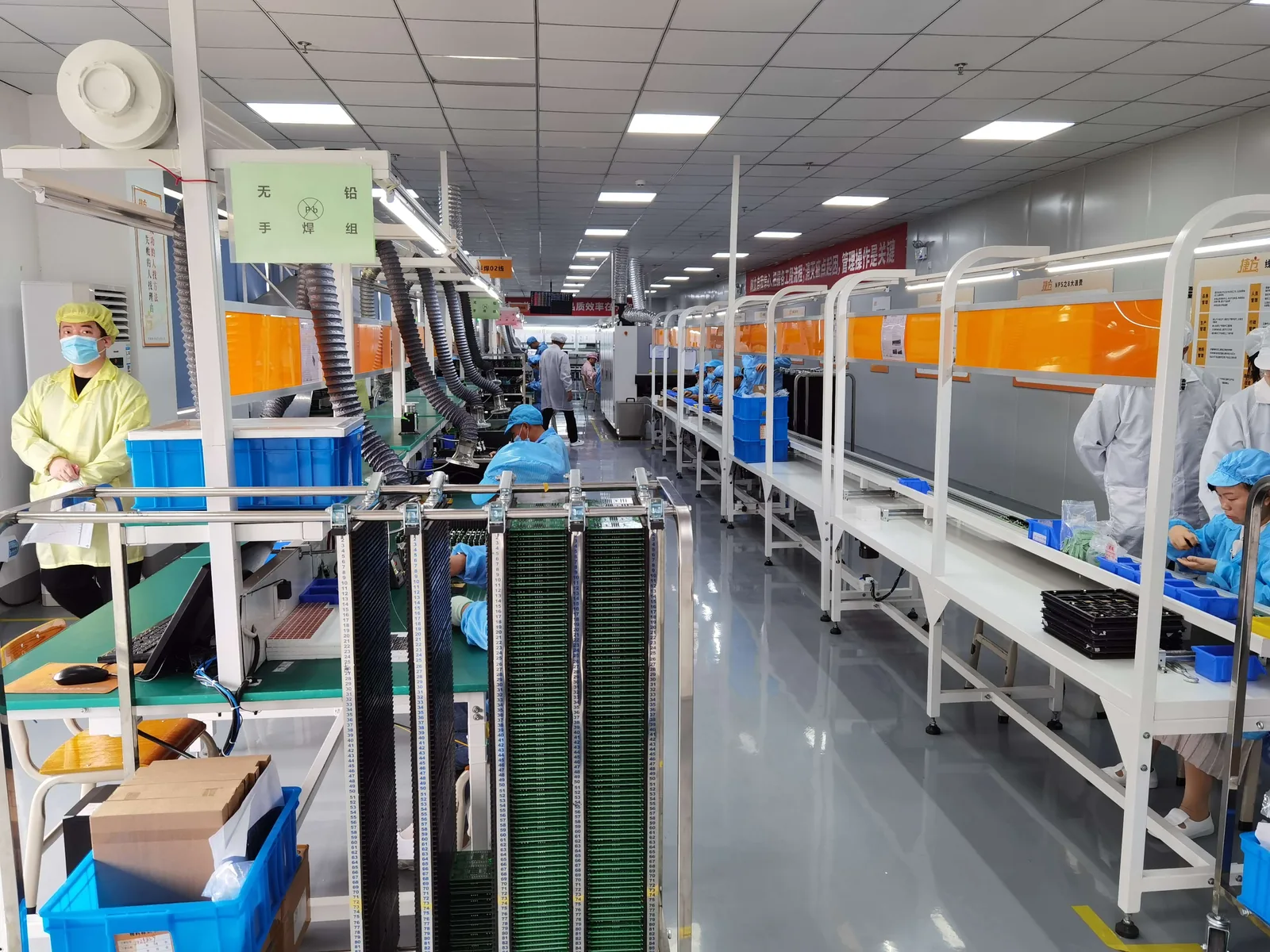
One board, two processes, one order of operations.
A mixed board goes through surface-mount reflow, then through-hole insertion, then wave or selective soldering. Those three stages cannot be reordered freely: reflow runs hot enough to destroy an inserted connector, and a wave after reflow will re-melt joints that were already accepted by inspection.
So the sequence is fixed by the design, and the design is reviewed against it. Which side gets reflowed first, whether a heavy part survives a second cycle, and where a connector sits relative to the wave are all settled at DFM review — before the stencil is cut, and before the panel is committed to a route.
What the board looks like decides the route.
Where the second pass changes
| Board feature | What it forces | What the route becomes |
|---|---|---|
| Bottom-side surface-mount plus through-hole | A full wave would reflow the bottom-side parts | Reflow both sides, then selective soldering joint by joint |
| Through-hole only on one area, surface-mount elsewhere | Part of the panel can take a wave, part cannot | Wave on the clear area, selective on the congested one, same order |
| Heavy parts on the second side | Another reflow cycle, plus mechanical load | Pass order flipped so the heavy side goes through first |
| Connector at a board edge | Mechanical load concentrated at the fingers | Supported and clinched before soldering, then inspected for fill |
| Press-fit connectors | No soldering at all | Inserted last, after every thermal operation is finished |
Press-fit is the case worth designing for deliberately: inserting those connectors before the last reflow destroys the compliant pin, and there is no rework that puts it back. Every build runs to IPC Class 2 standard, Class 3 on request.
Three things that decide whether a mixed build runs smoothly.
One BOM, one review
The surface-mount and through-hole lines share a BOM. Splitting the same board between a placement house and a soldering house means the second one inherits decisions it did not make — a pass order already fixed, a stencil already cut, a keep-out already violated. One review, one set of answers.
The second pass has a thermal budget
Every part on the second side sees the full profile again, plus whatever the wave adds. Plastic-bodied electrolytics, some connectors and most battery holders have a cycle limit, and it is checked against the datasheet at DFM review rather than discovered as a deformation after the run.
Test coverage spans two passes
A fault introduced in the second pass hides the same way as one from the first. Inspection is placed after each stage — paste and placement on the surface-mount side, joint inspection after soldering — so a defect is attributed to the operation that caused it instead of to the order as a whole.
Board with both technologies and no fixed order?
Send the assembly drawing with the sides marked and the heavy parts named. The pass order comes back with the quote.
Questions about boards that need both.
What actually makes a board mixed technology?
Any board carrying both surface-mount and through-hole parts. In practice that is most production boards, because connectors, transformers and cased capacitors have no surface-mount equivalent that survives the same mechanical load. A board with only through-hole parts is not mixed — it skips reflow entirely.
Why does mixed assembly cost more than the two processes separately?
It does not, usually — it costs more than either one alone, which is a different statement. The extra work is the second pass itself and the protection it needs: pallets, selective nozzles, fixturing, and an inspection point between the stages. That is one order with one DFM review rather than two vendors handing off.
Can heavy through-hole parts go through a second reflow?
Sometimes, and the datasheet decides. A part that is rated for one reflow cycle may not be rated for two, and gravity plus thermal expansion is a worse combination for a tall part than for a flat one. Where the answer is no, the pass order is flipped so that side goes through once.
Can the order be split between two suppliers?
It can be, but the second supplier inherits the first one’s decisions without having reviewed them. In practice that shows up as a keep-out that was never respected, a pass order that cannot be run, or a part that was already cycled twice. It is cheaper to keep the board in one building.
How do you know which pass caused a defect?
By inspecting between the passes rather than only at the end. Paste and placement are checked on the surface-mount side before reflow, joints are inspected after soldering, and X-ray covers the area-array packages. A defect caught after stage two but not after stage one belongs to stage two.
Mixed board and the pass order still open?
Send the assembly drawing and the BOM. Quote in 24 hours, with the sequence written into it.