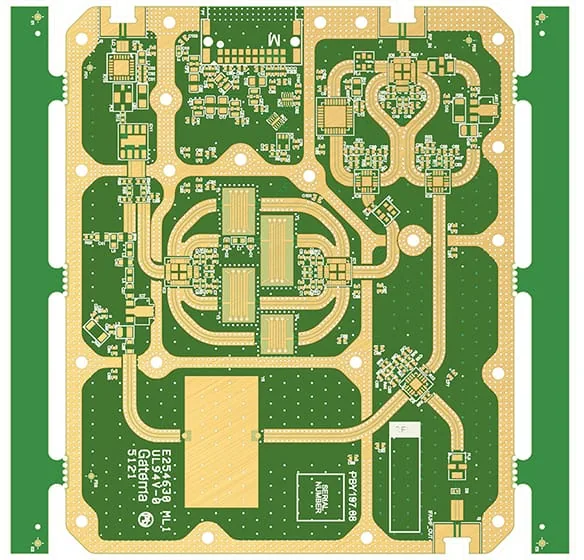
Heavy Copper Design Rules: Current, Etch and Thermal Vias
At 3 oz the etchant travels sideways through 105 µm of copper, so the minimum space opens to 0.20 mm and the trace section becomes a trapezoid.
Read article

On an insulated metal substrate the aluminium is the spreader, not the bottleneck. The dielectric is the thinnest layer and the worst conductor on the stack, which makes pad area and isolation thickness the two decisions that actually set the junction temperature.
An insulated metal substrate is three thermal resistances in series: the dielectric, the aluminium core spreading heat sideways, and the interface where the plate meets its sink. The dielectric is both the thinnest layer and the worst conductor — 1 to 3 W/m·K on a standard grade, 8 to 12 on a ceramic-filled one — so its term governs the total. Upgrading the core does not fix a dielectric that is too thin or too weak, and it is the most common misreading of an aluminium board quote.
| Layer | What matters | Typical value | Condition |
|---|---|---|---|
| Dielectric | Conductivity | 1–3 W/m·K standard, 8–12 ceramic-filled | Per grade |
| Dielectric | Thickness | 75–150 µm | Isolation class and grade |
| Aluminium core | Conductivity | ≈130–170 W/m·K | Alloy and temper, 25 °C |
| Aluminium core | Thickness | 0.5–1.2 mm | Stiffness and spreading |
| Circuit copper | Finished weight | 1–3 oz | String current per IPC-2152 |
Conductivity belongs to its layer and its condition. Whole-board thermal resistance depends on source area and geometry, so it is calculated per design rather than merged into one number for an aluminium board.
The one-dimensional term is thickness over conductivity times area. At 100 µm of a 2 W/m·K grade under a 10 cm² source that is about 0.050 °C/W; a 4 W/m·K grade halves it, and doubling the core thickness moves the total by a fraction. The lever is area and grade — the pad under the die is where the layout either helps or fights the substrate.
Two layout habits cost real degrees. The first is a thermal pad sized to the die footprint exactly, which gives the heat nowhere to spread before it has to cross the dielectric. The second is running signal traces through the pad area, which breaks the copper into islands and turns one spreader into several narrow ones. Copper under and around the die is cheap; the dielectric is what is being paid for.
On a single-sided substrate there is no plated through via into the core, so heat leaves by conduction through the dielectric rather than by a via farm. That is why the dielectric grade, not the copper weight, is the first thing to upgrade when a junction budget fails — and why a hole that has to pass through the aluminium needs an insulating sleeve rather than a plated wall.
The dielectric also carries the isolation requirement, so thickness is chosen once and paid for on both sides of the decision: thinner is thermally better and electrically tighter, and the grade and the withstand voltage have to be settled together rather than in sequence. Withstand is verified by hi-pot at the class stated on the drawing, on the finished part rather than on a coupon.
Layout matters here because the dielectric is at its thinnest where copper runs close to a routed edge. A copper pour taken to within a few tenths of the profile leaves no margin at the exact place where the part is handled, and the failure shows up as a breakdown at the edge rather than under the die. Set an explicit copper-to-edge distance for the isolation class and keep it in the pour rules, not in a note.
The same logic applies between voltage domains on the plate. A mains-side string and a control-side string on one substrate need a documented separation, and the figure belongs on the drawing alongside the dielectric thickness — a layout that respects it by accident will not survive the next revision.
Current capacity is not a property of an ounce. Per IPC-2152, ampacity is read at a stated width, thickness, temperature rise and environment, then compared against what the string actually draws. On LED plates the more useful calculation is often voltage drop, because a strip that dims at the far end is a resistance problem rather than a thermal one.
| Copper | Drop per metre at 2.0 mm width | Cross-section against 1 oz | Where it fits |
|---|---|---|---|
| 1 oz (35 µm) | ≈0.246 Ω/m | 1× | Signals, low-current strings |
| 2 oz (70 µm) | ≈0.123 Ω/m | 2× | Main loops, metre-class strips |
| 3 oz (105 µm) | ≈0.082 Ω/m | 3× | High-current feeds, dense rails |
Computed from copper resistivity at 20 °C at the stated width. At 2 A over a metre of 2 oz that is about 0.25 V one way — roughly 2% of a 12 V rail, and twice that once the return path is counted.
White solder mask does optical work in a lighting fixture, and it yellows under sustained heat. The aging condition — temperature and hours — belongs on the drawing rather than being assumed from a generic mask specification, because a mask that holds colour at 80 °C may not at 120 °C.
ENIG is the default finish for LED plates. Immersion silver is a cost-effective alternative with one boundary: in sulfur-bearing atmospheres silver tarnishes, so a sealed luminaire and an industrial installation do not get the same answer. That is an environment class on the drawing, not a purchasing preference.
Two quotes for the same drawing can differ by a third on the strength of what was left unstated. The comparable set is six lines: core alloy and temper, dielectric grade and thickness, finished copper weight, surface finish, panel format and utilisation, and the flammability listing — verified on the dielectric recognition rather than assumed from the fact that the core is metal.
Each missing line is a question worth asking before the order rather than after first article: which alloy and temper, which dielectric grade and thickness, finished or base copper, which finish and why, how many pieces per panel at what border, and V-0 on which layer’s listing. When those six are answered, the spread between quotes narrows to process class rather than to specification.
Mostly no. The stack is three resistances in series and the dielectric governs: about 0.050 °C/W at 100 µm and 2 W/m·K under a 10 cm² source, a figure that barely moves when the core thickness doubles. Core thickness buys stiffness and spreading on large plates; thermal upgrades start with the dielectric grade.
It depends on four conditions rather than one number: width, thickness, temperature rise and environment. In practice 1 oz carries signal and low-current strings, while 0.5 W-class strips and above move to 2 oz, where the drop arithmetic — about 0.123 Ω/m at 2.0 mm — protects end-of-strip brightness.
Only as far as the isolation class allows. Thickness is chosen against the withstand voltage, so thinning it is an electrical decision before it is a thermal one. Where more thermal headroom is needed inside the same isolation class, the grade goes up rather than the thickness going down.
Because the same drawing is not the same six lines. Alloy and temper, dielectric grade and thickness, finished copper weight, surface finish, panel utilisation and the flammability listing all move the price, and a 4 W/m·K dielectric is not the same purchase as a 1 W/m·K grade with the same thickness.
Inside its band, yes. FR-4 conducts at about 0.2 to 0.3 W/m·K against 1 to 3 for a standard metal-core dielectric, which clears the junction budget for sparse indicator panels under roughly 1 W/cm². If the calculation only passes at 25 °C ambient, the answer is the metal-core plate, not the cheaper laminate.
At 3 oz the etchant travels sideways through 105 µm of copper, so the minimum space opens to 0.20 mm and the trace section becomes a trapezoid.
Read article
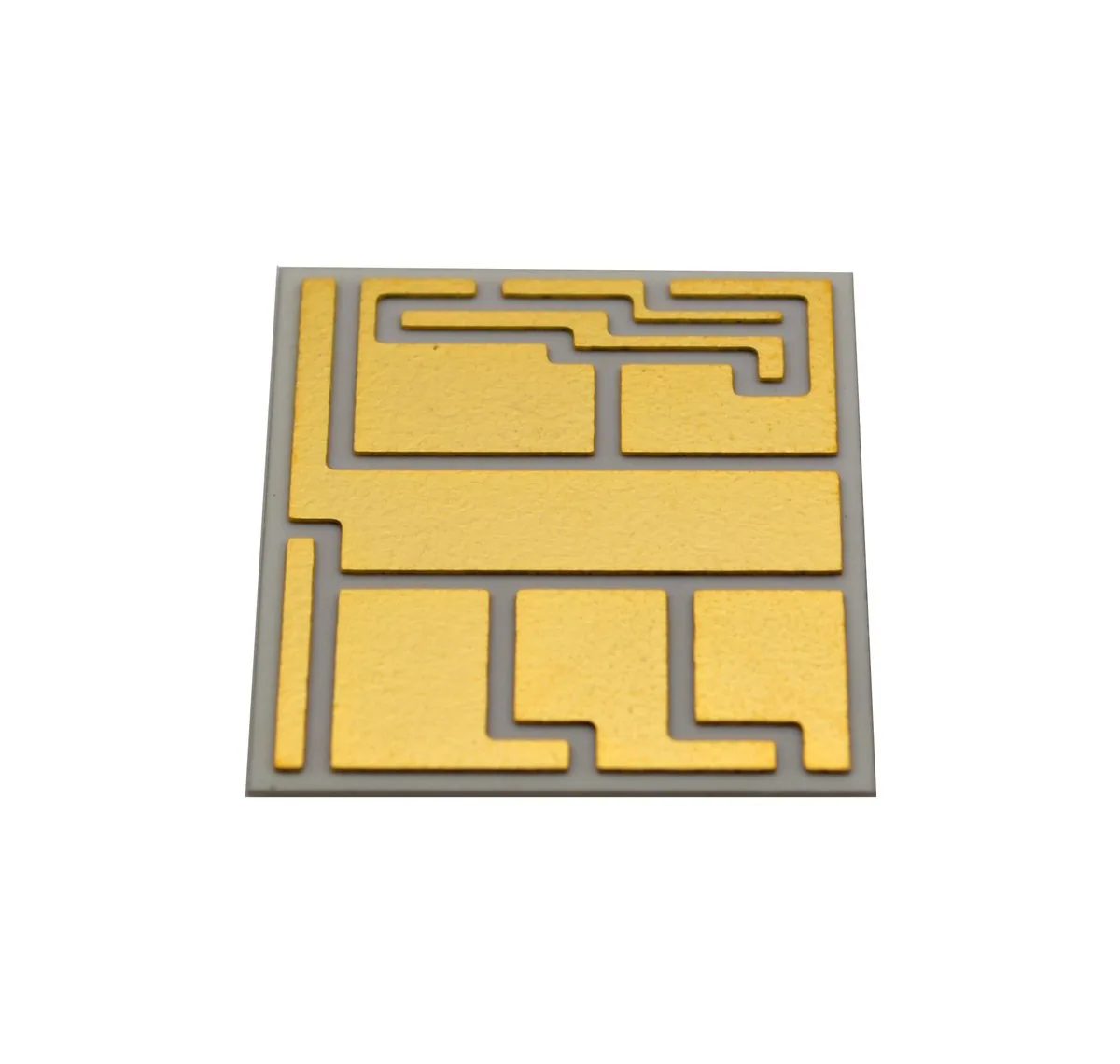
Alumina at 20–24 W/m·K and AlN at 170 against 0.2–0.3 for FR-4, plus the crossover arithmetic that decides which one ships.
Read article
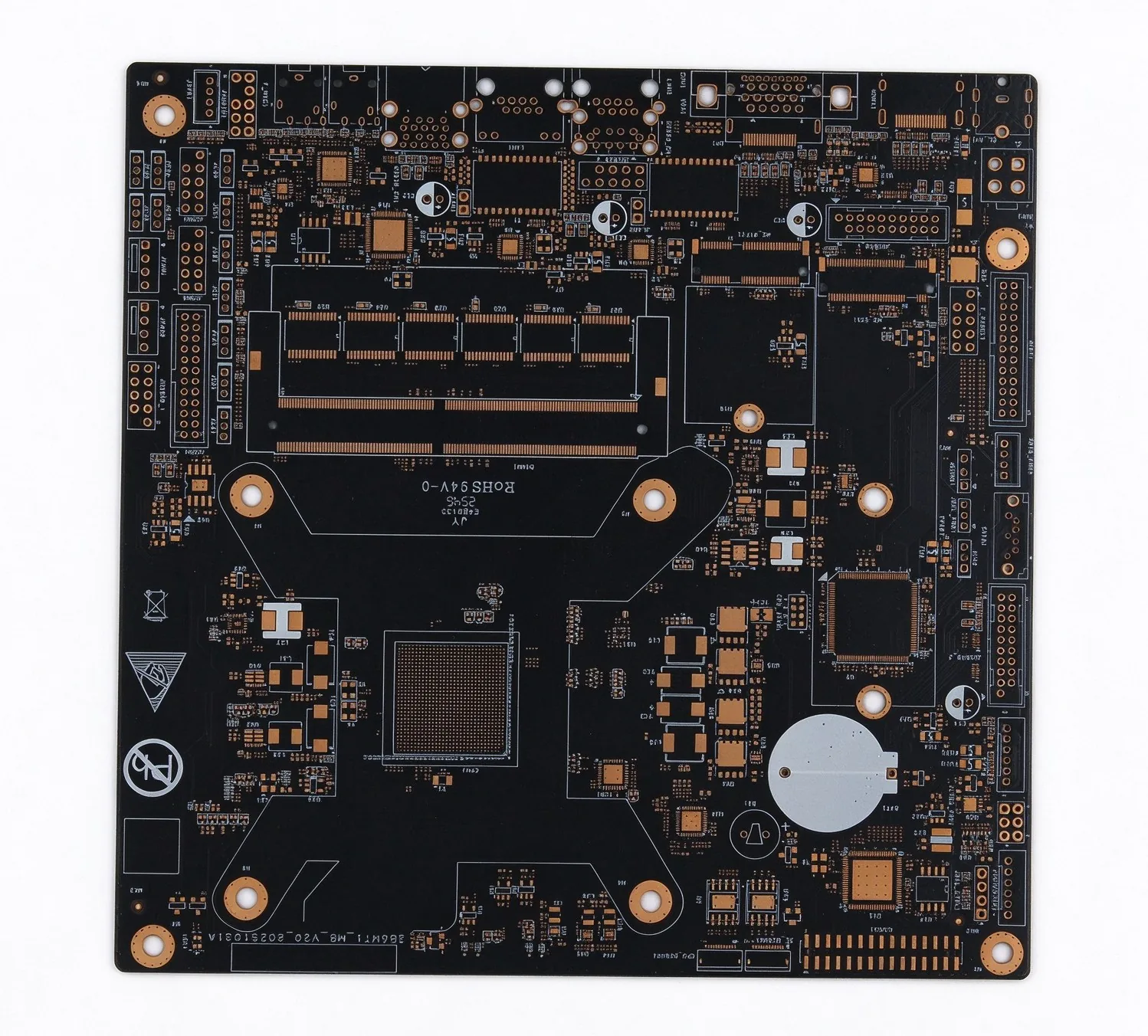
Six finishes on flatness, shelf life and cost, and the two questions that remove four of them immediately.
Read article
Send the LED placement, the drive current and the isolation class. Quote in 24 hours, with the dielectric grade named. Every build runs to IPC Class 2 standard, Class 3 on request.